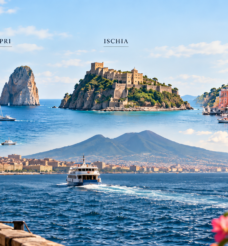
Anyone walking from Piazza del Plebiscito towards Castel dell’Ovo will come across one of the city’s most mysterious and fascinating places: Monte Echia. An ancient hill, supported by massive walls, criss-crossed by tunnels and connected by a panoramic lift leading to a terrace suspended over the Gulf of Naples. From up there, the view takes in the sea, Vesuvius and the city lights in a scene that seems to belong more to myth than to reality.
And it is precisely here that myth, history and geography intertwine until they become inseparable. When the Greeks from Cuma landed in the gulf between the 8th and 7th centuries BC, they were seeking a strategic location: defensible, close to the sea and symbolically powerful. Monte Echia embodied all of this. It was here that Parthenope, the first urban settlement of what would become Naples, was founded.
According to legend, the name derives from the siren Partenope, a mythological creature who tried in vain to seduce Ulysses with her song. Defeated by the hero’s refusal, she let herself die and her body was carried by the waves to the shores of the gulf. The Greeks decided to bury her on Monte Echia itself, transforming that place into a sacred space. From that symbolic tomb arose a city destined to live forever suspended between beauty and melancholy.
The myth of Partenope is not merely an ancient tale. It is the very soul of Naples. Like the siren, the city seduces and disorients, welcomes and eludes, captivates and tests. Those who visit Naples often cannot explain why they fall so deeply in love with it: it is as if they feel an invisible pull. An ancient song made of sea, light, salty wind, unexpected alleyways and absolute passions.
Even today, Partenope seems to live on in the city’s most iconic spots. Her presence lingers amongst the waves lapping at Castel dell’Ovo—which tradition identifies as the site of her tomb—and the terraces of Posillipo, where the sun sets over the sea, offering almost unreal views. She lives in the silent stairways that suddenly open out onto the blue of the gulf, in the hidden courtyards of the historic centre, in the voices of the Neapolitans, in the music that springs spontaneously from the streets, and in the city’s ability to transform pain into beauty.
Naples is, in fact, a dual city, just like the siren: half land and half sea, half rational and half instinctive. It constantly exists between opposites: Vesuvius and the sea, chaos and contemplation, destruction and rebirth. It is this constant tension that makes Naples unique on the European scene and transforms it into one of Italy’s most magnetic destinations.
Those wishing to discover this more authentic and mysterious side of the city must stray from the most obvious tourist routes. Beyond the crowds seeking the perfect pizza or the Maradona mural, there is a hidden Naples made up of deserted stairways, forgotten noble palaces, ancient brotherhoods, secret bookshops and small historic cafés where time seems to have stood still.
It is precisely this lesser-known Naples that I try to share with my guests through the cultural itineraries linked to my holiday home, Casetta Correra, whilst also providing a small library dedicated to the city’s history, legends and mysteries. Because ‘ ’ Naples, like Partenope, cannot truly be conquered: it must be listened to. And only those who allow themselves to be guided by its song can grasp its deepest soul.
Bibliography
B. Croce: Benedetto Croce “Storie e leggende napoletane”, Adephi, 1996
V. Del Tufo: “Napoli magica”, Neri Pozza, 2018
M. Serao: “Leggende napoletane”, Colonnese editore, 1999