“Houses wedged into the bowels of the rock, clinging to one another as in a living nativity scene, telling stories of another Naples, like an upside-down city, labyrinthine and mysterious with its stone torrents sliding towards the sea. A metropolitan canyon and the ancient bed of the mythical Sebeto, the river dear to the gods and poets.” (…) “More than a road, dizzying open wounds in the tuff. An irregular, deep furrow, the sort that only time can carve, resisting it and never yielding. Antennas, washing lines, tuff quarries, steps, mysterious passageways, ramps, piperno portals, ancient warehouses, churches, palaces, votive shrines, teeming humanity along a winding route of just 550 metres.”
These are some of the accounts found online about the “Cavone” (Via F.S. Correra): a street little known to Neapolitans, surprisingly quiet (despite leading to Piazza Dante) and shrouded in a truly unique atmosphere.
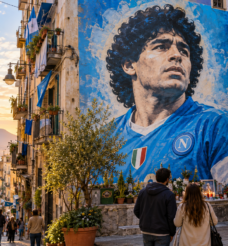
Together with a friend of mine, I have published a little book about this street and the illustrious general who was born and lived there (who, incidentally, used to go and read war comics as a child in the room where my holiday let is now located: Casetta Correra); you can download it as a PDF or buy it online; here are a few lines.
You’re bound to be disappointed if you look for the many dazzling sights of Naples’ city centre in Cavone, already captured on the smartphones of hurried tourists. Not least because the street seems to hide its secrets, revealing them only to those who know where to look.
Like the modest doorway which, after a low, narrow passageway, leads you into a surprising maze of staircases and balconies, once the film set for the movie ‘Into o Paradiso’, which celebrates a street characterised by an astonishing coexistence of people of all kinds, including thousands upon thousands of Sri Lankans. Another wonder to discover
Like a narrow alleyway where, if you look up, you can glimpse a luxurious roof garden. Or palaces with entrances on Via Correra and on another street above: a ‘hideout’ over the centuries for numerous criminals. Or a chapel, now deconsecrated, dating back to the second half of the 16th century…
Places sometimes overlooked on the many tourist excursions that have recently begun to take place in Cavone. Which, of course, focus on the already famous features of this street such as: the Palazzo della Conigliera, the many private gardens that line it (one of which is home to a gigantic specimen of Ficus magnolioides: a tree that stands out, usually in February, when a deafening chirping announces that flocks of migratory starlings have alighted there), the stunning tuff quarry (now a garage), the setting for * * and countless TV dramas, the numerous warehouses, the ancient aqueducts now open to visitors, the shop where *Ischirogeno* was born; a cordial which, in the last century, was one of the most widely consumed in Europe, thanks in part to the Coca it contained…