by Francesco Santoianni
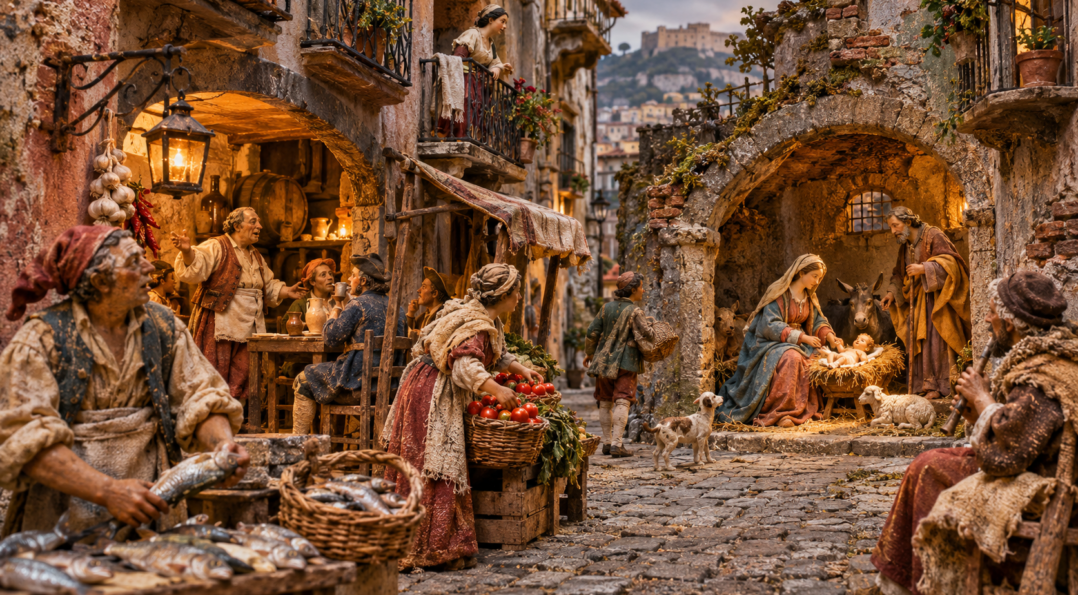
In San Gregorio Armeno, sometimes it’s the tomatoes that make you stop. Tiny, arranged on a greengrocer’s counter, they look as if they’ve been placed there by someone who actually shops at the market. A little further on, an innkeeper holds court among his patrons. A woman leans out from a balcony. And the Baby Jesus? You have to look for him. In the Neapolitan nativity scene, the Nativity finds its place amid a bustling city.
If you visit Naples in December, I suggest two stops. The first is San Gregorio Armeno, where you can browse the shops and ask how a shepherd is made. The second is the Certosa di San Martino, where the Cuciniello nativity scene shows what happens when hundreds of figures are brought together by someone with the eye of a director.
When Bethlehem Took on a Neapolitan Accent
The collections at San Martino preserve medieval wooden nativity figures. But it was especially in the 18th century that the nativity scene took on the appearance we still recognize today in the shop windows of San Gregorio Armeno. Around the Holy Family, artisans depict the clothing, trades, and gestures of the people of the Kingdom of Naples. One need only look at the figures from the Monks’ Nativity Scene, featured by the National Archaeological Museum of Naples, to understand how closely the artisans observed the life around them. A young shepherd and a peasant woman, with their clothes and accessories, convey a sense of place and time just as much as the classical ruin serving as the backdrop to the Nativity. Campania Regional Directorate of National Museums
In Naples, in the language of the Nativity scene, even a figurine that has never seen a sheep is called a shepherd. And a single figure can represent several trades. In some 18th-century examples, the head is made of painted terracotta, the eyes are glass, and the body—shaped with wire and tow—is covered in fabric. The General Catalog of Cultural Heritage lists materials ranging from hemp to velvet for a single male figure. The next time you stop in front of a Nativity scene, look at the sleeves, the shoes, and the way a character holds his basket. That’s where a figurine begins to resemble a real person. mann napoli|Archaeological Museum of Naples
San Gregorio Armeno: How to Enjoy the Street of Nativity Scenes
From Casetta Correra, you can walk to San Gregorio Armeno, the street of nativity scenes. From Piazza Dante, pass under the Port’Alba arch and continue along Via dei Tribunali. On the way back, you can take Spaccanapoli and stop at Piazza San Domenico Maggiore. In December, I’d choose a weekday morning—that way, it’s easier to linger in front of the shop windows without having to rush off right away. The shops are also open during the rest of the year. Italia.it
My advice is to start with a detail. Look at what’s on the table at the tavern, how the fish are arranged on the counter, or where the artisan has hidden the light illuminating a window. Then look up. You’ll notice that from one shop to the next, even the way the same scene is depicted changes.
If you want to take home a souvenir, choose a character and ask how it was made. It could be a fishmonger, a woman with a basket, or an innkeeper who reminds you of someone you met during your trip. A single shepherd is enough to get you started. By next Christmas in Naples, you’ll find him some company.
The Cuciniello Nativity Scene, where it’s worth waiting for nightfall
At the Certosa and Museum of San Martino in the Vomero district, the Cuciniello Nativity Scene takes center stage in the nativity section. Michele Cuciniello donated a collection of about eight hundred pieces—including figures, animals, and accessories—to the state and personally oversaw the installation, which was inaugurated in 1879. The scene unfolds on what is called a scoglio in Neapolitan nativity scenes—the structure that supports and organizes the landscape. Three distinct episodes stand out here. The Nativity takes place amid the ruins of a Roman temple, the tavern is full of patrons, and, in another section, angels bring the good news to the shepherds. Campania Regional Directorate of National Museums
Take the time to see how the scene changes as the lights dim. The lighting simulates dawn, day, sunset, and night. A corner you might have missed in broad daylight may become the first thing you notice at dusk. In the galleries, also look for the scarabattoli, the display cases that enclose individual scenes. They’re perfect for getting a close-up look at the animals and the miniature food and utensils. Campania Regional Directorate of National Museums
To get there from Piazza Dante, take the Metro Line 1 to Vanvitelli and continue on foot uphill toward Largo San Martino. If you’re in Naples during the holidays, check the official opening hours for the Certosa and the Nativity scene section before you go. anm.it
On your way back, if you pass through Pignasecca, stop for a moment in front of a fish stall. Watch how the vendor arranges his wares and leans out to speak with a customer. After a day spent observing the shepherds, you’ll find yourself thinking that all the artisan had to do was step out of his workshop to find his next character.
If you’re coming to Naples to see the nativity scenes, staying at Casetta Correra lets you plan your visits without rushing. From Piazza Dante, you can walk to the shops on San Gregorio Armeno and take the metro up to Vomero, where the Cuciniello nativity scene awaits you. Between visits, you can head back to the apartment for a break on the terrace. And in the evening, after the hustle and bustle of the narrow streets, you’ll find the tranquility of Via Correra just a short walk from the historic center.